
How to define what you need from your next car
Write a short buying brief before browsing so attractive listings do not distract you from everyday requirements.
The worked examples are fictional. Use the worksheets with your own listings and quotations; example amounts are not market prices.
On this page
Start from the Trips You Actually Make
To begin defining your car requirements, it’s crucial to understand your actual travel needs. A practical approach is to keep a one-week journey diary. Record details such as the number of passengers, the amount of luggage, parking situations, and the routes you take. Avoid focusing on specific car models at this stage.
Daily vs. Rare Trips
Identify which trips are part of your daily routine and which are rare occurrences. For example, if you commute to work every day, note the typical number of passengers and any luggage you carry. Consider whether you frequently need to park in tight spaces or navigate narrow streets. For rare trips, such as family vacations or occasional long-distance travel, assess whether renting a vehicle or using alternative transport might be a viable option. This can help you avoid purchasing a car that is larger or more expensive than necessary for your regular use.
Example Journey Diary Entry
- Monday: Commute to work, 1 passenger, laptop bag, city parking.
- Wednesday: Grocery shopping, 2 passengers, 5 shopping bags, suburban parking.
- Saturday: Family outing, 4 passengers, stroller, picnic basket, park parking.
Turn Wants into Observable Checks
Once you have a clear picture of your travel needs, translate your desires into specific, observable checks. This will help you make informed decisions when evaluating potential cars.
Practical Checks
-
Large Boot Space: If you need a large boot, test it by seeing if it can accommodate your pushchair plus a few bags. This is more reliable than relying on volume measurements alone.
-
Easy Parking: Measure your own parking space and consider the width of the car, including mirrors. Check if you can comfortably open the doors in your typical parking environment.
-
Comfortable Ride: Instead of assuming features like heated seats equate to comfort, test drive the car to see if the driver’s seat is comfortable for you over a longer period.
Home Charging Access
If you are considering an electric vehicle (EV), assess whether you have access to home charging. This is a crucial factor that can significantly impact the convenience and cost-effectiveness of owning an EV. However, do not automatically assume an EV is the best choice without considering your specific circumstances.
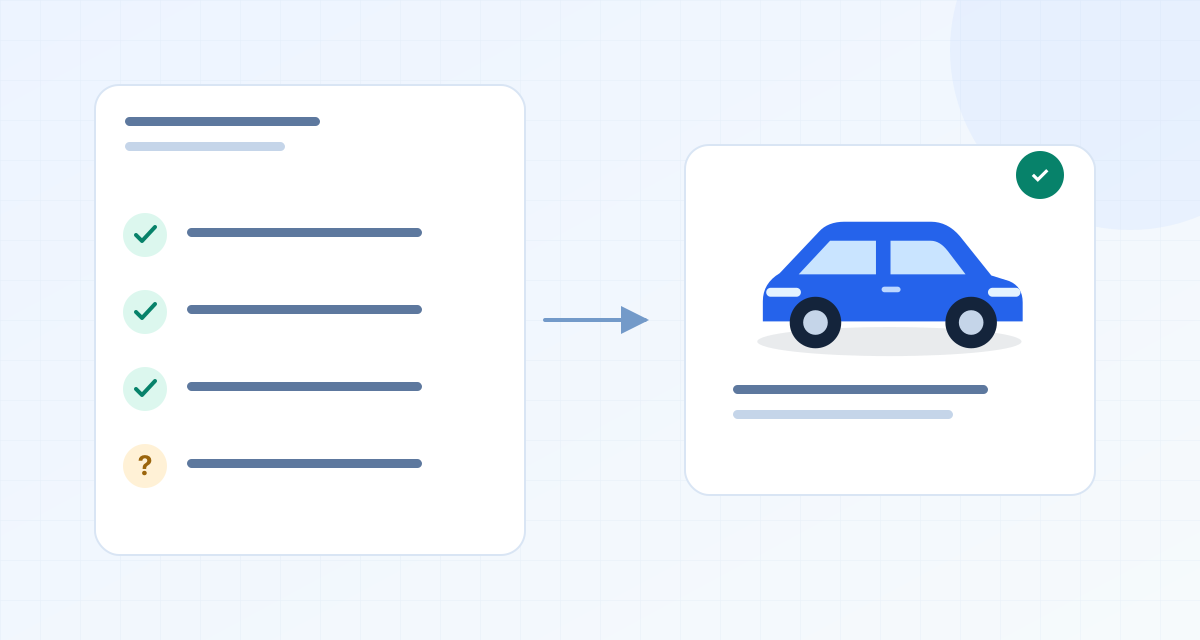
Make Three Lists: Essentials, Preferences, Open Questions
Creating three distinct lists will help you prioritize your needs and clarify any uncertainties.
Essentials
These are the non-negotiable features your car must have to meet your daily requirements. Unsupported claims should not be included as essentials unless verified.
- Example Essentials:
- Seats for 4 passengers
- Boot space for a pushchair
- Fuel efficiency for daily commutes
Preferences
Preferences are features that would enhance your driving experience but are not strictly necessary. They can guide your decision if multiple cars meet your essential criteria.
- Example Preferences:
- Sunroof
- Advanced infotainment system
- Leather seats
Open Questions
These are aspects you need to explore further before making a decision. They might include uncertainties about new technologies or specific features.
- Example Open Questions:
- Is hybrid technology suitable for my driving habits?
- How does the car perform in winter conditions?
- What are the maintenance costs for this model?
Worked Fictional Family Brief
In this chapter, we will explore a fictional family scenario to define car requirements. The family consists of two adults who need a vehicle that can accommodate a pushchair and fit into their garage. An automatic transmission is essential for their needs. The family has identified three potential car options: Car A, Car B, and Car C. Each car has different attributes and requires specific tests to determine suitability.
-
Car A: This car is claimed to have an automatic transmission, but the fit for the pushchair has not yet been tested. The family needs to measure the boot space to ensure the pushchair fits comfortably. The measurements will be recorded as blanks until they are measured.
-
Car B: This car has been confirmed to have a manual transmission, which automatically disqualifies it from consideration since an automatic is essential for the family.
-
Car C: This car is confirmed to have an automatic transmission, but it is unknown whether it will fit in the family’s garage. The family needs to measure the car’s dimensions against their garage space to confirm compatibility.
Compact Table: Gate/Status/Next Action
| Car | Transmission evidence | Pushchair fit | Garage fit | Next action |
|---|---|---|---|---|
| A | Automatic claimed in ad | Unknown | Unknown | Confirm transmission and test both fits |
| B | Manual confirmed | Not assessed | Not assessed | Exclude: fails transmission requirement |
| C | Automatic confirmed | Unknown | Unknown | Test luggage fit and parking access |
Test Gates Before Scoring
Before scoring the cars, it is crucial to ensure that all essential requirements are verified. Car B cannot win with options because it fails the essential requirement of having an automatic transmission. Therefore, Car B is disqualified from further consideration.
Cars A and C remain pending until the necessary tests are completed. Both need a luggage and parking check; A also needs confirmation of its advertised transmission. Do not fill an untested field with “yes” just because the car has passed a different requirement.
Only after all essential requirements are verified can the family compare preferences and score the cars based on their weighted criteria. The family may choose to use a weighted scoring system to evaluate the cars based on comfort, practicality, and features.
Example Weighted Scoring
Let’s consider two different weighting scenarios for scoring the cars:
-
Comfort 40%, Practicality 35%, Features 25%
- Car A: Comfort 4, Practicality 3, Features 4
- Score = (4 * 0.40) + (3 * 0.35) + (4 * 0.25) = 3.65
- Car C: Comfort 3, Practicality 4, Features 4
- Score = (3 * 0.40) + (4 * 0.35) + (4 * 0.25) = 3.60
- Car A: Comfort 4, Practicality 3, Features 4
-
Comfort 25%, Practicality 50%, Features 25%
- Car A: Comfort 4, Practicality 3, Features 4
- Score = (4 * 0.25) + (3 * 0.50) + (4 * 0.25) = 3.50
- Car C: Comfort 3, Practicality 4, Features 4
- Score = (3 * 0.25) + (4 * 0.50) + (4 * 0.25) = 3.75
- Car A: Comfort 4, Practicality 3, Features 4
In the first scenario, Car A scores slightly higher than Car C, while in the second scenario, Car C scores higher. This near-tie situation suggests that the family should revisit their subjective inputs and preferences to determine which car best meets their needs. It is important to remember that these scores are not automatically generated; they are based on the family’s subjective evaluation of each car’s attributes.
Build a Cost Brief Without Guessing a Final Bill
When planning to purchase a car, it’s crucial to build a comprehensive cost brief. This involves identifying all potential costs without attempting to predict the exact final bill. Here are the key components to consider:
-
Vehicle Price: Start by noting the advertised price of the vehicle. This is the base cost and can vary significantly depending on the make, model, year, and condition of the car. Ensure you have this information clearly documented.
-
Upfront Quoted Fees: These are additional costs that may be required at the time of purchase. They can include registration fees, taxes, and dealer fees. Always ask the seller for a detailed breakdown of these fees to avoid surprises.
-
Recurring Estimates: Consider the ongoing costs associated with owning the vehicle. This includes insurance, maintenance, fuel, and any financing payments if applicable. It’s important to keep the period consistent, so decide whether you’ll calculate these on a monthly or annual basis and stick to it.
-
Unknowns: There may be costs that are not immediately apparent, such as potential repairs or unexpected maintenance. While these cannot be precisely calculated, it’s wise to acknowledge their possibility in your budget.
-
Reserve Chosen by Buyer: Set aside a reserve fund for unforeseen expenses. This is a personal decision and should be based on your comfort level and financial situation. Document the amount you decide to reserve.
By organizing these elements, you can create a structured cost brief that helps you understand the financial commitment involved in buying a car without attempting to predict the exact total cost.
Prepare a Viewing Test
When preparing to view a car, it’s essential to conduct a thorough test to ensure it meets your needs. Here’s how to prepare:
-
Bring Usual Items: Gather items you typically carry in your car, such as a pushchair, luggage, or sports equipment. This will help you assess the vehicle’s practicality.
-
Both Drivers Present: If the car will be used by more than one driver, ensure all drivers are present during the viewing. This allows everyone to test the driving position and comfort.
-
Measure Aperture and Boot: Check the size of the door apertures and the boot space. Use a tape measure to ensure your usual items fit comfortably. This is particularly important for families or those with specific storage needs.
-
Doors Within Actual Parking: Open and close the doors within a typical parking space to ensure they operate smoothly and without obstruction.
-
Adjust Seat and Check Passengers: Adjust the driver’s seat to your preferred position and then check the comfort and space for passengers in the back. Repeat this process to ensure everyone can travel comfortably.
-
Request Permission for Tests: Always ask the seller for permission before conducting any tests or inspections. If you have specific concerns about the car’s condition, consider seeking professional help for a more detailed assessment.
Copyable Buying Brief
Creating a buying brief helps you stay focused on your requirements and preferences. Here’s a template with an example filled in:
-
Must Have: [Pushchair Fit]
- Evidence: [Measured boot space with pushchair]
- Test: [Fit pushchair during viewing]
- Owner: [Both drivers]
- Preference: [Spacious boot]
- Unknown: [Long-term reliability]
- Revisit Trigger: [If boot space is insufficient]
-
Must Have: [ ]
- Evidence: [ ]
- Test: [ ]
- Owner: [ ]
- Preference: [ ]
- Unknown: [ ]
- Revisit Trigger: [ ]
This template helps you organize your thoughts and ensures you don’t overlook any critical requirements during the car-buying process.
Resolve an Impossible Brief
When faced with an impossible car-buying brief, it’s crucial to first identify which preferences can be relaxed without compromising essential needs. This approach ensures that the core requirements of the household are met while allowing for some flexibility. For instance, if the initial brief demands a car with both high fuel efficiency and a large engine capacity, consider relaxing the engine capacity requirement if fuel efficiency is more critical for daily commutes.
A change in household needs often necessitates a documented revision of the car requirements. For example, a growing family might prioritize additional seating over a sporty design. Documenting these changes helps avoid the pitfall of chasing a favorite car that doesn’t meet the updated needs. Instead, focus on how the revised requirements align with the current lifestyle and future plans. Record these changes in a structured manner, noting the reasons for each adjustment. This documentation will serve as a valuable reference throughout the car-buying process.
Coordinate Shared Needs
When coordinating shared needs among multiple household members, it’s essential to gather individual briefs before considering specific brands or models. Each person should outline their requirements, such as the need for a spacious trunk or advanced safety features. This process helps in identifying potential conflicts early on.
Conflicts should be stated clearly as use cases. For example, if one person requires ease of access due to mobility issues, this need cannot be averaged away or compromised. Instead, prioritize finding a vehicle that accommodates this requirement while still addressing other needs. Document these shared needs and conflicts in a consolidated brief, ensuring that all voices are heard and considered. This approach facilitates a more harmonious decision-making process and helps prevent misunderstandings later.
Four FAQs
-
Essential vs. Nice-to-Have Features: How do we differentiate between them?
- An essential is a requirement you cannot give up without making the car unsuitable for its intended use—for example, enough seats for its regular passengers. A preference improves your experience but permits a trade-off. Write the reason and a practical test for each essential; do not promote equipment to essential merely because it appears in a favourite advertisement.
-
What if We’re Uncertain About a Feature?
- If there’s uncertainty about the necessity of a feature, consider its impact on daily use. For example, if unsure about the need for a built-in navigation system, evaluate how often you travel to unfamiliar places. Document these considerations and revisit them as you gather more information.
-
How Do We Assign a Numeric Score to Preferences?
- Assigning a numeric score can help prioritize features. Use a simple scale, such as 1 to 5, where 1 is least important and 5 is most important. Each household member can score features individually, and then these scores can be averaged to reflect the collective priority. Record these scores in your brief for easy reference.
-
What Triggers a Change in the Brief?
- Changes in the brief can be triggered by shifts in lifestyle, such as a new job requiring a longer commute or the addition of a family pet needing more cargo space. Document these triggers and the resulting changes to ensure that the brief remains relevant and accurate.
Draft Five Checks Now
To ensure a comprehensive car-buying brief, draft five checks that will guide your decision-making process:
- Verify Essential Features: Confirm that all essential features are clearly listed and prioritized.
- Document Shared Needs: Ensure that the needs of all household members are documented and conflicts are addressed.
- Review Preferences: If you use scores, check that they apply only after the essentials pass and that the weights still reflect your priorities. Scoring is optional.
- Update for Changed Needs: Revisit the brief to incorporate any recent changes in household needs.
- Prepare for Comparison: Use the documented brief to compare potential vehicles, referring to choose-a-car-together and compare-car-equipment for additional guidance.
You can keep the buying brief and any manual scores in Garageview notes. The worksheet is your decision method, not an automatic scoring feature of the app.
Published by Garageview.ai, with AI-assisted drafting and translation. These guides explain our suggested buying workflow; they are not vehicle inspections or independent marketplace rankings.